Platform Value Proposition
Use these ten dimensions to evaluate how ARPIA can help you adopt artificial intelligence (AI) while retaining your existing systems and limiting operational disruption.
ARPIA follows the principle of "From Legacy to Freedom": build on your existing technology investments rather than replace them. Each dimension describes the value, potential business impact, and implementation approach, from investment optimization to security and risk management.
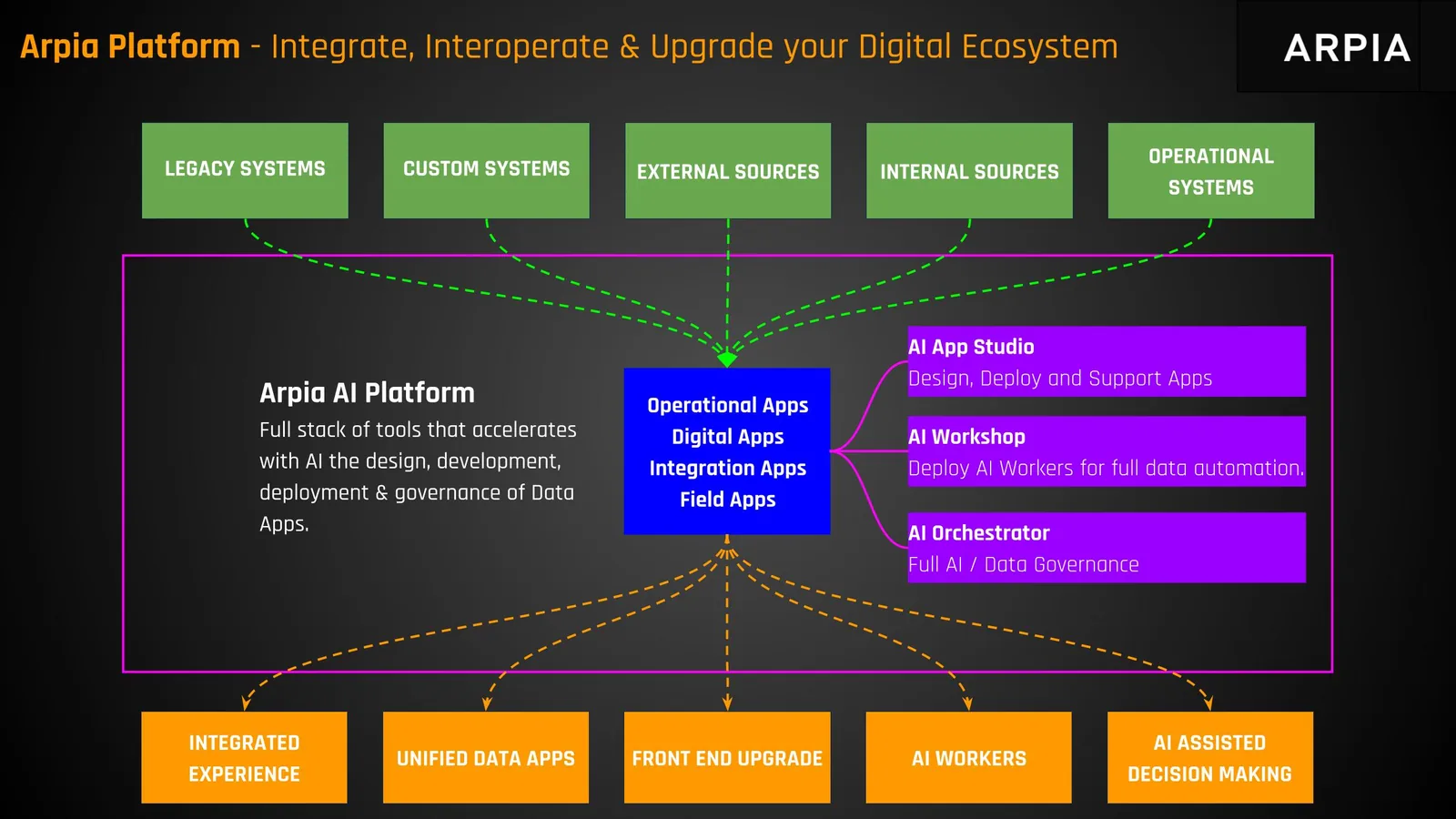
ARPIA integrates with your existing infrastructure and provides security controls to support AI deployment across your organization. Use the implementation approaches below to assess how the platform fits your operational, security, and compliance requirements.
1. Intelligent Investment Optimization#
Value#
- Maximizes return on investment (ROI) from existing infrastructure
- Eliminates unnecessary expenditure on new systems
- Builds on current technology investments
Impact#
- Optimized budget allocation
- Reduced capital expenses
- More resources available for strategic initiatives
- Enhanced operational efficiency
Implementation#
- Integrate with your existing systems without replacing them.
- Enhance your current capabilities gradually.
- Use AI to optimize your existing resources.
2. Minimal Operational Disruption#
Value#
- Integration of new capabilities with existing systems
- Continuous business operations during implementation
- Preservation of critical processes
Impact#
- Reduced implementation risks
- Maintained productivity during transitions
- Smooth technology adoption
- Enhanced operational continuity
Implementation#
- Deploy new capabilities in phases.
- Run systems in parallel during the transition.
- Monitor operations and make adjustments in real time.
3. Enhanced End-User Experience#
Value#
- Improved efficiency through data consolidation
- Simplified processes and workflows
- Intuitive user interfaces and interactions
Impact#
- Increased employee productivity
- Enhanced decision-making capabilities
- Faster and more effective results
- Reduced training and adaptation time
Implementation#
- Design workflows around your users' needs.
- Customize interfaces for each user role.
- Bring knowledge management into your workflows.
4. Innovation Acceleration#
Value#
- Rapid development of digital solutions
- Integration with current systems
- AI-powered development and deployment
Impact#
- Faster development of new solutions
- Enhanced adaptability to market changes
- Improved competitive positioning
- Faster time-to-market for new solutions
Implementation#
- Use AI-assisted development tools.
- Automate deployment pipelines (sequences of steps that release software).
- Use continuous integration and continuous deployment (CI/CD) to automate the integration and release of code changes.
5. Sustainable Scalability#
Value#
- Flexible technological foundation
- Infrastructure that supports changing requirements
- Adaptable architecture
Impact#
- Sustainable long-term growth
- Improved adaptability
- Continued use of existing investments as requirements change
- Reduced technical debt (maintenance work caused by earlier design or implementation trade-offs)
Implementation#
- Use cloud-native architecture (software designed to run in cloud environments).
- Scale workloads with Kubernetes (a platform for managing applications packaged in containers).
- Use microservices (small services that work together as an application).
6. Data Governance and Compliance#
Value#
- Centralized platform for data control
- Clearer records of data changes and use
- Compliance with security regulations
Impact#
- Reduced legal and regulatory risks
- Improved information transparency
- Enhanced audit capabilities
- Strengthened data protection
Implementation#
- Automate compliance monitoring.
- Conduct regular security audits.
- Manage data throughout its lifecycle, from creation to deletion.
7. AI-Powered Process Automation#
Value#
- Automated routine tasks
- Intelligent workflow management
- Advanced decision support
Impact#
- Reduced operational costs
- Improved accuracy
- Faster processing times
- Enhanced resource allocation
Implementation#
- Use AI Workers to automate tasks.
- Coordinate tasks across workflows.
- Use machine learning models (systems that learn patterns from data) to optimize processes.
8. Unified Knowledge Management#
Value#
- Centralized knowledge repository
- Integrated data access
- Enhanced information sharing
Impact#
- Improved decision-making
- Less information isolated within individual teams or systems
- Enhanced collaboration
- Better resource utilization
Implementation#
- Use the Knowledge Grid architecture for knowledge management.
- Use semantic search (search based on meaning rather than exact keywords).
- Visualize data to help users interpret information.
9. Enterprise Integration Capabilities#
Value#
- Connections with existing systems
- Unified data access
- Standardized integration protocols
Impact#
- Better information exchange between systems
- Reduced integration complexity
- Enhanced data consistency
- Streamlined operations
Implementation#
- Use an API-first architecture (design application programming interfaces before building the systems that use them).
- Use standard integration protocols (shared rules for exchanging data between systems).
- Generate custom connectors to link systems.
10. Security and Risk Management#
Value#
- Comprehensive security framework
- Risk mitigation strategies
- Compliance management
Impact#
- Enhanced data protection
- Reduced security risks
- Improved compliance status
- Protected business operations
Implementation#
- Apply security controls at multiple layers of your system.
- Assess security regularly.
- Automate risk monitoring.
Conclusion#
Evaluate ARPIA against your organization's priorities:
- Financial impact: Optimize costs and improve ROI.
- Operational efficiency: Improve productivity while maintaining business operations.
- Development and deployment: Reduce the time needed to build and release solutions.
- Risk management: Strengthen security and support compliance requirements.
- Adaptability: Scale your architecture as requirements change.
Use these priorities to identify where AI can improve your operations while preserving existing investments.