
Request a pilot
Private AI · Self-hosted · On-premise

Your own AI platform. Private, governed, yours to keep.

One private AI platform your company runs as its own, with a team that puts it to work. Start with a pilot on our infrastructure. Scale on yours, self-hosted or on-premise, when you decide.

  • Reversible pilot, three months at most.
  • No long-term commitment.
  • Your data and your knowledge stay yours.
  • An ARPIA engineer alongside your team during the pilot.
SOC 2 Type II, audited by A-LIGN ISO 42001 certified, audited by A-LIGN

SOC 2 Type II and ISO 42001, audited by A-LIGN.

Request a pilot

Tell us what you want to solve. Someone from the team writes back to set up a first conversation.

By submitting this form you agree to be contacted by ARPIA Technologies about your request. We never share your information. Privacy policy.

What ARPIA is

ARPIA is the private AI operating system for the enterprise.

Like an operating system, it is the one layer where all your models, agents and data run under the same rules. On top sits Oria, the workspace where your people do the work.

Oria, the workspace

Where business users work with AI every day: ask, analyze, and build applications and agents on your data. No technical team required.
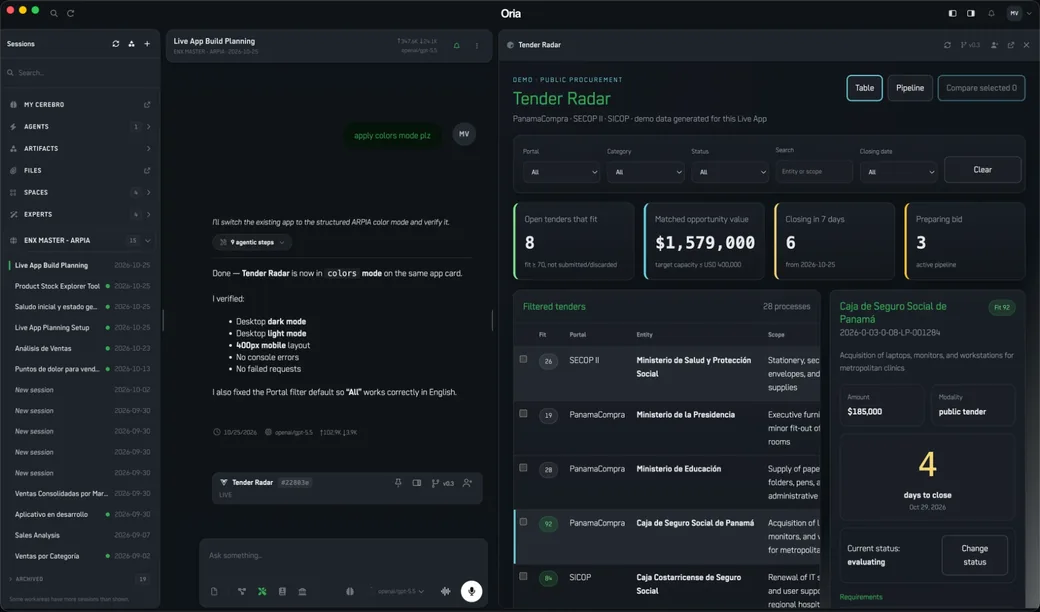
Oria on a laptop: the session list on the left, a request typed in plain language in the center, and on the right the working application Oria built from it, a demo tender tracker with filters, totals and a table
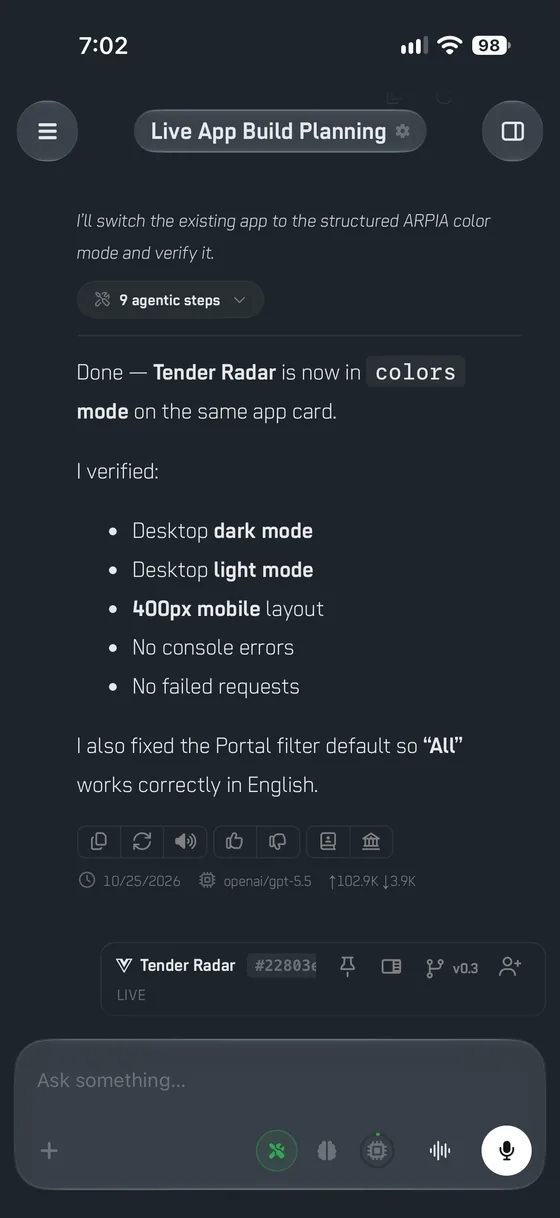
Oria on a phone: a conversation where the assistant reports the checks it ran on an app it built.

Oria runs on the infrastructure your organization designates, not on each person’s computer.Every Oria operation in your company happens there. Work continues when laptops are closed, and each person picks it up from their desk or their phone.

The infrastructure underneath

Connects your systems, runs any model and any agent, and governs who may do what, with which budget, keeping a record of every action.

The Reasoning Ontology in ARPIA, Domains view: each business domain, such as sales, purchases, inventory, accounting and CRM, drawn as a group of its data nodesThe Reasoning Ontology in ARPIA, Relationships view: the business domains as a graph, with lines for the relationships between themThe Reasoning Ontology in ARPIA with the items catalog selected: its links to stock, inventory adjustments, purchases, suppliers and salesThe Reasoning Ontology in ARPIA, Connections view: a customer churn dataset in the middle, the data it is built from on the left and what it feeds on the right
The whole business, by domain
A rack server with the ARPIA logo on its front panel, lit in gold against a black background
The same platform, on your own servers when you decide.
At the center

Your enterprise ontology

A living map of how your company works: its customers, products, orders and rules, and how they relate. It sits above your systems of record, and every model and every agent works through it.

Models change every few months. Your ontology is what lasts. It is specific to your company and it stays with you.

Governance
Permissions, limits and the audit trail are set on the objects of your business, so the same rules reach every person, model and agent.
Two-way
It reads from a governed copy of your systems of record. What goes back goes through approved actions, with a person signing off where it matters.
Orchestration
Agents and automations run on the ontology, so each step uses the same definitions and the same rules.
Why a platform

One platform you own, instead of a stack of tools you inherit.

A typical AI consultancy

  • A new tool for every problem.
  • Many vendors, and you end up operating them.
  • Your data spread across services you do not control.
  • The knowledge leaves with the consultant.

ARPIA

  • One platform for every use case, model and agent.
  • One set of permissions, budgets and audit trail.
  • Your data in your instance, in your region or your data center.
  • The knowledge stays in your company, and our team deploys it with you.
Private by design

Private AI means yours. Every piece of it.

Your instance

Your workspace, your users, your rules. Nobody else's.

Your region

United States, Latin America or United Kingdom on our infrastructure.

Our infrastructure or yours

Start with us. Move to your cloud or your data center when you decide.

Runs anywhere

ARPIA runs entirely in containers: any cloud, any data center.

Open-source databases

Your data in open formats, never locked in a proprietary store.

Any model

Several providers and open models. Change the model when you want.

How you start

Pilot on our infrastructure. Scale on yours.

01

Pilot on ARPIA's infrastructure.

Nothing to install. Three months at most, enough to show value.

02

Validate with your data and your team.

Real cases, the people who do the job, and a result measured against today.

03

Scale where you decide.

Stay with us, or install ARPIA on your cloud or in your data center, inside your perimeter.

Your exit

Your exit, clear from day one

What ARPIA orchestrates is yours, whether you stay or leave.

Your data

In open-source databases, never in a proprietary format.

Your knowledge

Your institutional memory belongs to your company.

Your applications

Run them with us or on your own infrastructure, with full autonomy.

Ask us for the exit terms in writing before the pilot starts.

Questions

Frequently asked questions

Am I locked into ARPIA?

No. ARPIA is a platform you run as your own, not a consultancy's stack. Your data and your institutional memory are yours, the databases are open source, and the whole platform runs in containers you can host yourself. The pilot is reversible and asks for no long-term commitment.

Where does my data live during the pilot?

On ARPIA's infrastructure, in the region you choose: United States, Latin America or United Kingdom. If you later run ARPIA on your own infrastructure, your data lives wherever you decide.

What happens to my data when I use AI models?

You choose. You can use the models ARPIA provides, with no GPUs to buy. Our contracts with the model providers are zero data retention (ZDR): what is sent for each task is not stored on the provider’s side, and your data is never used to train models. Or you can run your own models, including open models inside your infrastructure, for your most sensitive work.

Either way, your data, your knowledge and your agents stay stored and governed in your own instance, separate from every other customer. If your standard requires that nothing leaves your walls, the platform and your own models run in your data center.

Can I install it on my own infrastructure?

Yes. ARPIA runs entirely in containers, so it runs on any cloud or in your own data center. After the pilot you decide whether to stay on our infrastructure or move it inside your perimeter, with full autonomy.

Can I change the AI model?

Yes. ARPIA works with several model providers and with open models, and you can change the model. Your data stays yours whichever model you use.

How long is the pilot?

Normally three months, which is what it takes to show value. It can be shorter. At the end you decide: stay on our infrastructure, move to yours, or stop.

Tell us what you want to solve.

Reversible pilot. No long-term commitment.

Request a pilot

Inside the infrastructure

Five screens from the platform your company would run.

The Reasoning Ontology in ARPIA, Domains view: each business domain, such as sales, purchases, inventory, accounting and CRM, drawn as a group of its data nodes
At the center

The enterprise ontology

Your company as a living graph: purchasing, sales, accounting, production and the rules that tie them together. Governance, the two-way link with your systems of record and the orchestration of agents all happen here.

The ARPIA module grid: data sources, data pipelines, AI governance, the operations board and the knowledge catalog

Connect your data

Data sources and pipelines feed your ontology, so every model and every agent works from the same facts.

The live operations board: running agents and processes grouped by project

Watch every agent at work

A live board shows what is running, what has finished and what needs a person.

Budget controls: a monthly token limit and an alert threshold for each AI model

Set the limits

A monthly budget for each model, with an alert before it runs out. Permissions decide who reaches which data.

A map of connections between data, knowledge and the agents that use them

See how it is wired

A map shows how data, knowledge and agents connect. Nothing runs as a black box.

Reversible pilot. No long-term commitment.Request a pilot

What your people do with Oria

Six applications built in Oria. Each one started as a request in plain language and runs on top of your systems of record, governed and private.

A reconciliation run in Oria: the bank statement on one side, the ledger on the other, matched entries joined by lines
Finance

Bank reconciliation

Upload the bank statement and Oria matches it against the ledger with the rules your team applies. Only the doubtful movements go to a person, and every run stays on record.

A receipt photographed on a phone next to the review screen where each field read from it is listed
Finance

Receipts and expense control

A photo of the receipt on the phone is enough. Oria reads each field, sends what it cannot read with confidence to a person, and finance follows every receipt.

An order tracking screen: a queue of orders with the late ones on top and the detail of one order beside it
Logistics

Order tracking

What the ERP, the warehouse and the carrier say about each order, in one queue with the late ones first and the reason for the delay.

A sales board: yearly totals on top, a monthly trend line comparing two years, and charts by category and brand
Management

Sales board

Sales for the year, the monthly trend against last year, and the breakdown by category, brand and warehouse, read from the invoices themselves.

A board of sales agents working in sequence, each card showing its queue, success rate, cost and limits
Sales

A line of agents

Agents that prospect, research, qualify and draft the first email, each with its queue, cost and limits. A person approves every message before it goes out.

An inventory screen: search filters, stock totals and a product list with the stock of one product by warehouse
Operations

Inventory

The whole catalog with what is really available by branch and warehouse, searchable by name or reference.

Reversible pilot. No long-term commitment.Request a pilot